
Verify Payson Voter Registration
Use Utah's Find Voter Registration screen for the first check. It is an identity-based service for a voter checking a personal record, not a browse-by-name directory of everyone in Payson. Enter the four required facts exactly as the voter has them on file. Submit the form, then review the returned status, precinct, districts, and election details. If the record does not appear or the status looks wrong, do not keep changing facts at random. Contact Utah County Elections so staff can resolve the mismatch.
| Field | Type | Required | Notes / Format |
|---|---|---|---|
| First Name | Text | Yes | Use the exact label shown by the state tool. |
| Last Name | Text | Yes | Enter the name tied to the record. |
| Date of Birth | Masked date text | Yes | The field applies a date mask. |
| Zip | Masked text | Yes | Use the ZIP tied to the voter record. |
| Search | Button | No | Submits the four identifying fields. |
The broader Utah voter information portal is the source behind this Payson check. Its result can also lead to ballot, polling-place, and elected-official information tied to the authenticated voter. That personal result is not the same product as a county list or statewide file.
The official Utah portal shows what Payson voters should expect before entering personal details.
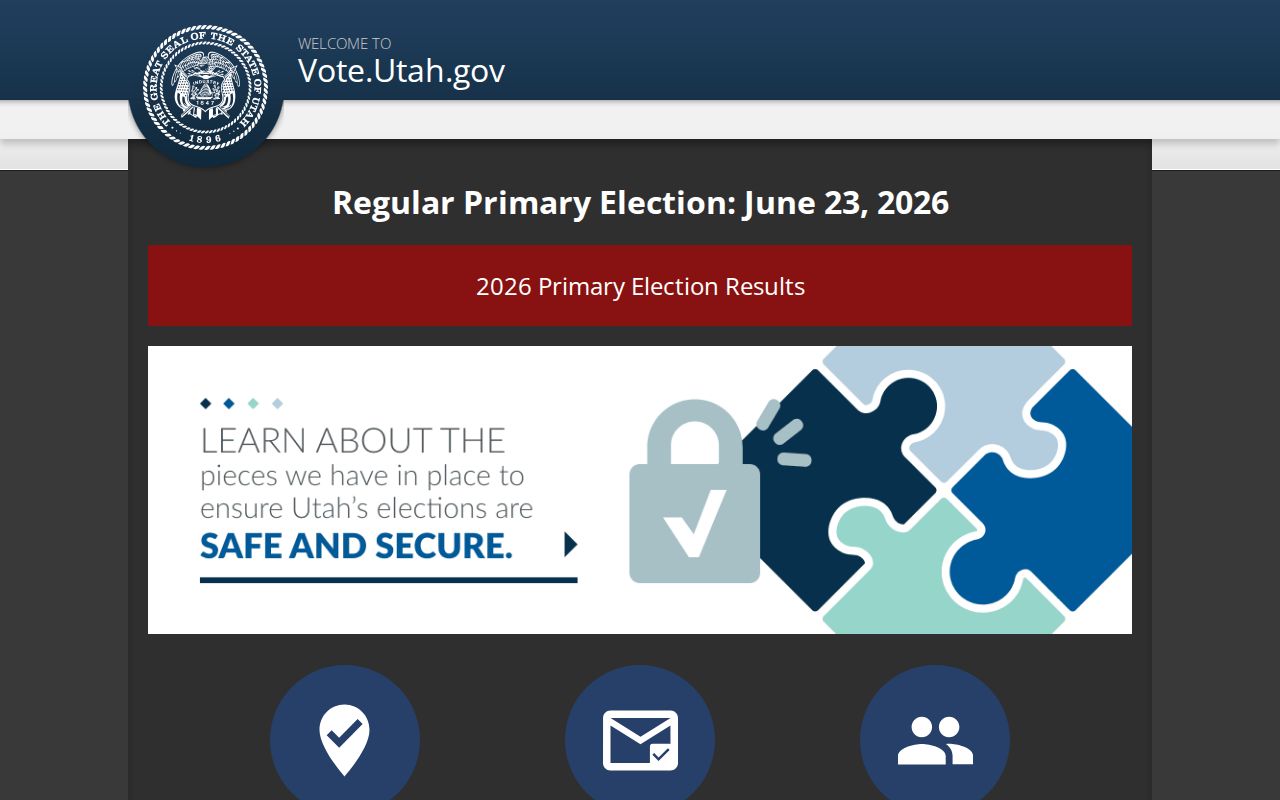
The screen keeps the individual verification route separate from bulk voter-data access.
Reading Payson Voter Records
A personal lookup may display more than a public voter file. The result can include an address, ballot mailing address, voting precinct, voting district, voter ID number, party affiliation, and voter status. It may also connect the voter to ballot and polling information. By contrast, Utah's standard public data uses an age band instead of a date of birth and includes participation for the prior eight years. Participation means whether someone voted, never how a ballot was marked.
| Identity | Full legal name plus voter ID and FIPS identifiers in standard data. |
|---|---|
| Location | Residence and unit, county, mailing city and address, subject to at-risk protection. |
| Districts | Precinct and congressional, legislative, school-board, county, and city-council districts. |
| Party and Status | Party affiliation and active or inactive status. |
| Age | An age band, not the voter's date of birth. |
| Participation | The preceding eight years of election participation, with no ballot choices. |
| Record Timing | The date the registration entry was last updated. |
Standard and at-risk are distinct classifications. Under Utah Code §§ 20A-2-601 through 608, at-risk voter data are not released to the public, parties, or candidates. The standard public file uses an age band, not a full birth date.
Utah's 2026 Voter Snapshot
Chapter 102, also known as SB153, replaced Utah's older voter-data framework with §§ 20A-2-601 through 608. The change altered fields, classifications, security, and permitted use. Updated releases paused from March 9 through May 25, 2026 while the new system took effect. Anyone using an older Payson list should date it and avoid treating it as a live status check.
The official voter-data page treats each release as a snapshot and specifies its effective data date. This distinction matters. A new registration, address change, or status correction after that date will not appear in the purchased copy. Verify current personal status through the lookup or the clerk instead.
The state's voter-data request page shows the classifications, products, and delivery terms that govern Payson records.
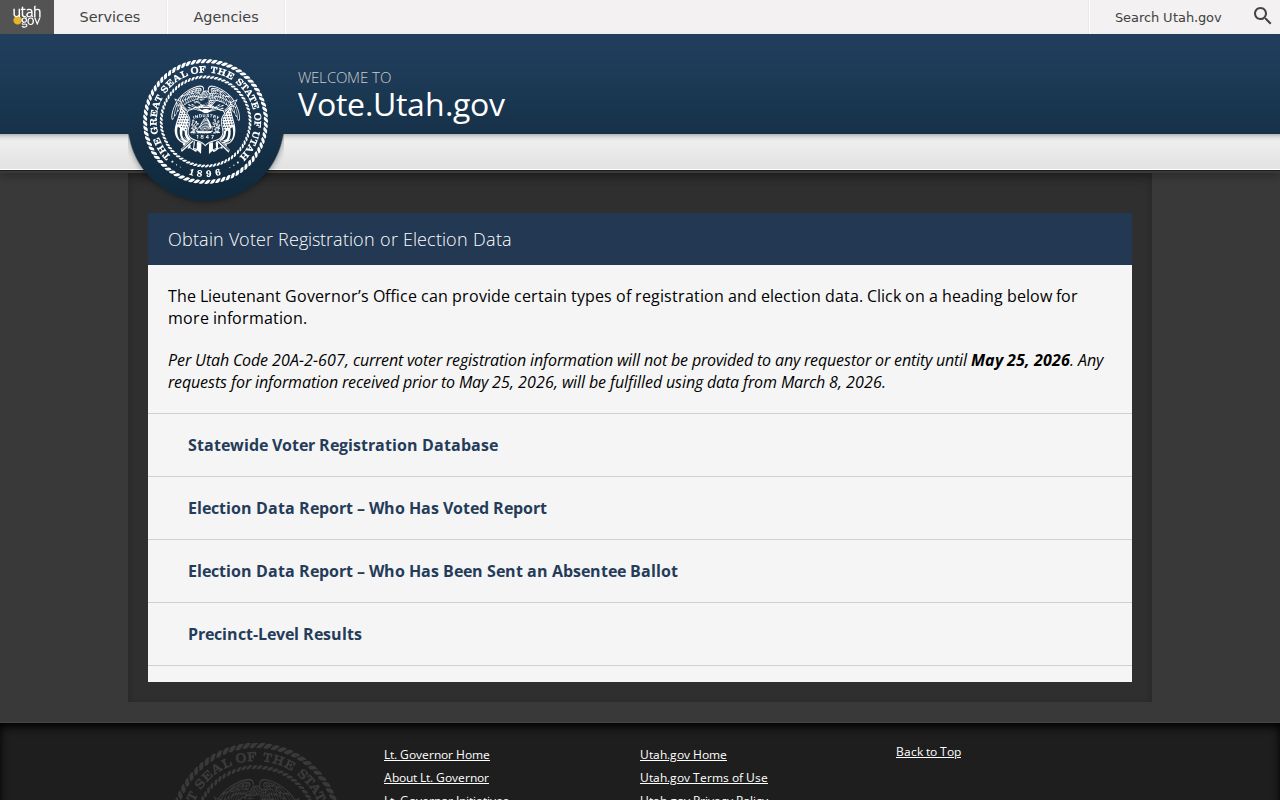
The dated-release notice is the key cue that a downloaded roll is fixed in time.
Payson Voter Registration Help
Payson lies within Utah County, so the county clerk's elections staff handle the local voter record. Utah County Elections is the fallback for a missing online result, an inactive notice, precinct questions, or a county data request. Staff can be reached at 801-851-VOTE or elections@utahcounty.gov. The office is at 100 E Center, Suite 3100, Provo, and the researched public hours are 8 a.m. to 5 p.m.
Utah County Elections
100 E Center, Suite 3100
Provo, Utah
801-851-VOTE
elections@utahcounty.gov
Hours: 8 a.m. to 5 p.m.
Best Route by Need
Personal status: Utah voter lookup
Local correction: county elections staff
County subset: certified county request form
The county elections page groups maps, voter services, and office contacts for Payson residents.
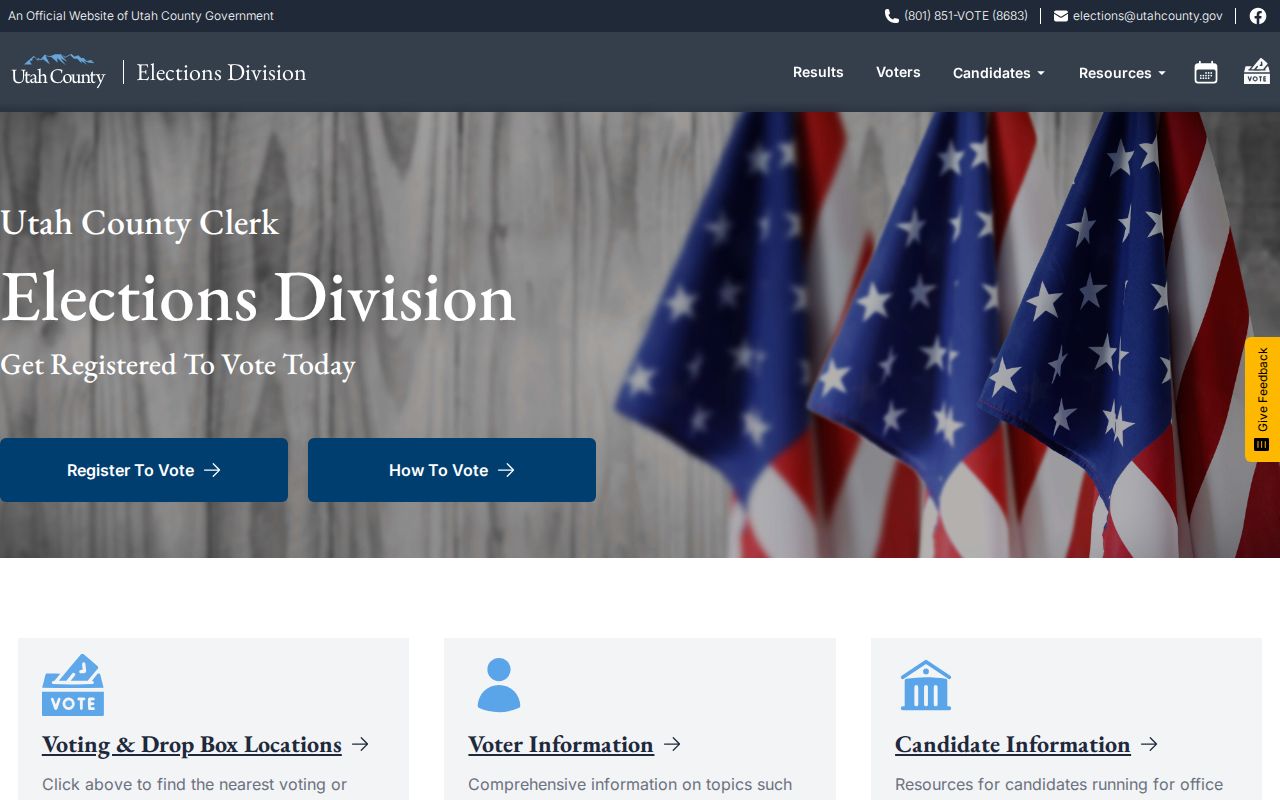
That county route is also the practical bridge between a statewide lookup and Payson's local precinct details.
Inactive Payson Voter Records
Utah's lookup warns that a record can become inactive after no voting in two regular general elections and no response to a clerk's notice. An inactive Payson voter does not receive a mailed ballot and should contact the clerk. The label does not reveal a ballot choice or prove that the person moved. It signals that the record needs attention through the elections office.
A cancelled label should also be checked with staff rather than interpreted from a stale file. Use the snapshot's update date, then compare it with a fresh personal lookup. This keeps list maintenance from being mistaken for evidence about a person's current home or civic activity.
Note: A downloaded voter roll can lag a later status correction, so use the authenticated lookup for the voter's current record.
Protecting Payson Voter Addresses
Utah's at-risk classification can protect qualifying threatened victims, law-enforcement personnel, public figures, armed-forces members, people covered by protective orders, and qualifying co-residents. Applicants use the state's voter privacy process with the required affidavit and proof. Once protected, the at-risk data are not released through public, party, or candidate voter files.
Utah's Address Confidentiality Program (ACP), known as Safe at Home, is a related but separate substitute-address and mail-forwarding program for qualifying survivors and threatened people. Government agencies accept the substitute address. Actual address, locality or precinct, phone, and other locating details can be confidential, while enrollment facts and older pre-enrollment records may not be. Certification lasts four years, and forwarded first-class mail typically adds three to five business days.
These protections do not turn every Payson voter record private. They apply through defined programs and election-law classifications, so a searcher should not infer that a missing address means no record exists.
The $1,050 Utah Voter File
The statewide voter file is a one-time product, not a free update or a subscription. The fee is $1,050 and is not refunded. Utah sends a link by email within one business day. The file is tab-delimited and about 150 MB, so the recipient needs software that can import delimited text without altering long identifiers or dropping leading zeros.
- Open the official state data-request page and choose the product that fits the permitted purpose.
- Complete the required identity, purpose, and legal certifications. State law limits who may receive and use these data.
- Pay the stated fee, then preserve the effective snapshot date with the delivered file.
- Import the tab-delimited download as data. Keep a clean original copy so formatting changes do not become false facts.
Two election reports cost $35 per election: Who Has Voted and Absentee Ballot Sent. They apply to regular even-year elections and can be produced daily during the 21-day window. Recent precinct results are free. None of these products discloses how anyone voted.
The large price is a useful boundary. Personal voter registration does not require buying the statewide roll. Most Payson residents need the free authenticated lookup or help from Utah County Elections.
County Voter Lists for Payson
The Utah County voter-list form can narrow a request by voters, party, precinct, district, or city. It asks for the requester's first and last name, email, mailing address, city, state, and ZIP. Phone and organization are also available. The requester must state a purpose, make six acknowledgments, certify with a full name, and submit the form.
The county charges a $5 setup fee plus $1 per 500 names. It invoices first, then provides an Excel file within two business days. Available voting history reaches from 2016 to the present. The form also offers Yes or No history selection and party controls. Its page partly cites an older statutory section, so the current 2026 Utah law controls eligibility and use.
County and state products serve different scales. The county route suits a lawful Payson or district subset; the statewide purchase covers the larger file. Both require purpose and use certifications.
Historical Payson Voter Records
A modern web lookup is not the end of the voter trail. Permanent or superseded registration records may transfer to the Utah Division of Archives and Records Service. Ask for a specific record series and a range of years. Exact Payson poll-book and registration-register coverage was not established in the research, so a request should not promise a run that the catalog does not confirm.
Older Payson sources may use Peteetneet, the settlement's early name, or Utah Territory headings. Those terms can help in archive catalogs, newspapers, and related civic records. A missing online name can mean an office book, microfilm, a catalog without full-text search, or a protected image. It does not by itself mean the record was destroyed.
Historical poll books document election administration in their own period. They should not be read as proof of a current address, current party, or present status.
Legal Limits on Payson Voter Data
Utah allows voter data only for a political purpose, an express statutory purpose, or a court-ordered purpose. Utah Code § 20A-2-607 makes obtaining data by false pretenses, using it for another purpose, posting it publicly, or disclosing it without authority a class A misdemeanor. County certifications also warn of civil and false-statement consequences.
Use voter rolls lawfully. Do not publish protected details, use false claims to obtain a file, or use any record to monitor, threaten, stalk, or harass a person.
Utah's stalking law, § 76-5-106.5, addresses repeated following, monitoring, surveillance, communication, appearances at a residence, contact with neighbors, and dissemination of information when the statutory harm standard is met. Keep research focused on lawful civic, family-history, or personal record needs. General government-record access is a separate system, explained through Payson public records procedures.
Ballot choice remains outside every access route. A voting-history field shows participation only, whether it appears in a personal result, a county product, or the state file.