
Starting a Payson People Search
No single official database lists every person connected to Payson. The useful first source depends on what is known. A full or partial name can be tested against Utah County ownership records, Utah court records, state professional licenses, or a business filing. An address is better suited to the county parcel map. A family name from an earlier era may require the Payson Cemetery, newspapers, yearbooks, or a catalog search under both Payson and Peteetneet.
Keep a small search log with the exact name, date, address, role, and record number from each hit. Common names can point to several Utah County residents. A middle initial, spouse, parcel serial number, license number, court case number, or dated street address provides the second point needed to separate them. The best route moves from a broad index to the office record that documents the event.
- Write down the known name, date range, former address, and any family or business association.
- Check Utah County land records for an owner, mailing address, parcel, or recorded party.
- Use the appropriate court route, keeping Payson Justice Court separate from Fourth District Court.
- For older family research, compare cemetery, obituary, directory, and official certificate evidence.
- Ask the correct custodian for a focused copy when an online index ends before the needed record.
Note: An index hit identifies where to look next, but the underlying image, case order, certificate, or agency copy carries the fuller context.
Why Payson Records Split by Jurisdiction
Payson is a city in southern Utah County, while Provo is the county seat. That division controls where a people search goes. The Payson City Recorder keeps city-created records such as council material, contracts, permits, and licenses. The county offices keep recorded deeds, property ownership, marriage licenses, and election files. Utah courts and state agencies maintain still other name indexes.
A mailing address that says Payson does not by itself prove the parcel lies inside city limits. Some addresses near the city can fall under a different local custodian, and an annexed parcel may have older permits in county files. Check the parcel boundary and the date of the event before sending a request. This geography step keeps a search from stalling at an office that never held the record.
Payson Records Offices That Hold Names
Three offices form the practical local core. The Utah County Recorder connects people to deeds, liens, plats, recorded licenses, and other land instruments. The Utah County Clerk handles marriage licenses and election functions. The Payson City Recorder routes requests for municipal files. The assessor and GIS staff add ownership, parcel, value, improvement, and map context, but an assessor entry does not replace the legal instrument recorded by the Recorder.
The county offices are based in Provo, not Payson. Online access handles many first checks, while counters, telephone help, mail, and written records requests remain important for copies or material outside a web index. Detailed classifications, charges, and request rules belong with Payson public records access.
Payson City Recorder
439 W Utah Avenue
Payson, UT 84651
Check current city contact details
Note: Check each official office page for current counter hours before traveling from Payson to Provo or visiting Payson City Hall.
Search Payson Land and Ownership Records
Utah County Land Records is the strongest official starting point when a name or parcel is tied to Payson real estate. Its routes cover owner name, property address, serial number, subdivision, appraisal details, abstracts, entry number, recording date, book and page, kind of instrument, legal description, document images, typed abstracts, and plat images. An abstract is the list of recorded instruments associated with a parcel. A vesting document is the instrument that supports the present ownership entry.
The Utah County Land Records search screen shows the county gateway used to move between property data and recorded documents.
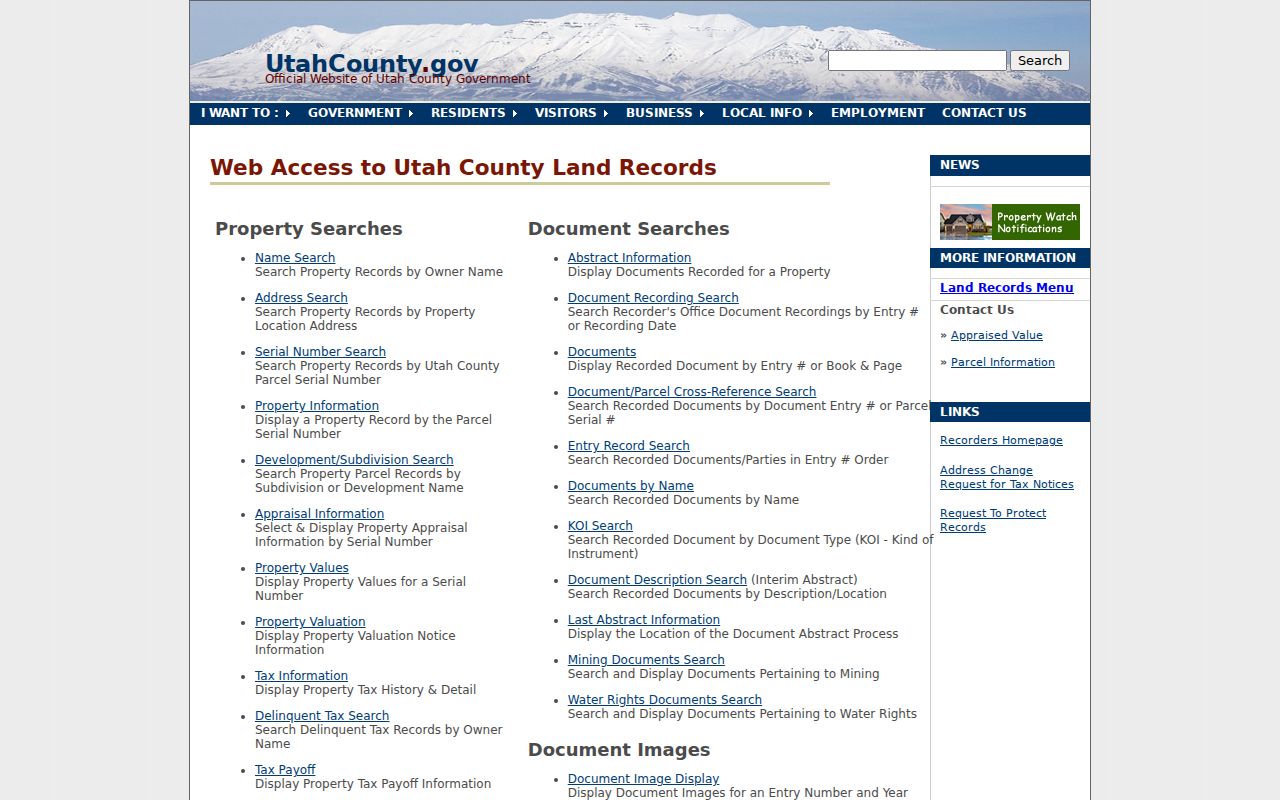
For a common surname, a known parcel often works better. Move from property information to the parcel abstract, then follow the entry number or book and page to the recorded image. The exact start of the complete electronic party-name index is not stated, so older gaps should go to the Recorder counter, mail-copy route, Archives, or cataloged microfilm rather than being treated as lost.
| Land search field | Input | Best use |
|---|---|---|
| Entry Number + Year | Text pair | Retrieve a known recorded instrument |
| Book + Page | Text pair | Open a cited volume location |
| Owner or Address | Name or street text | Find the present parcel trail |
| Serial Number | Digits, colons, spaces, or hyphens | Move among property, abstract, and map views |
Turn a Payson Address Into Names
An address-first search should begin with the Utah County Parcel Map. It accepts an address or common place, parcel serial, book and page, owner name, and township-range-section inputs. Serial numbers can appear as nine compact digits or in a form such as 12:345:6789. Copy the serial before leaving the map. It is the most reliable bridge into the parcel abstract, vesting document, assessment data, and older instruments.
The Utah County Parcel Map supplies the visual boundary and search tools behind this Payson address workflow.
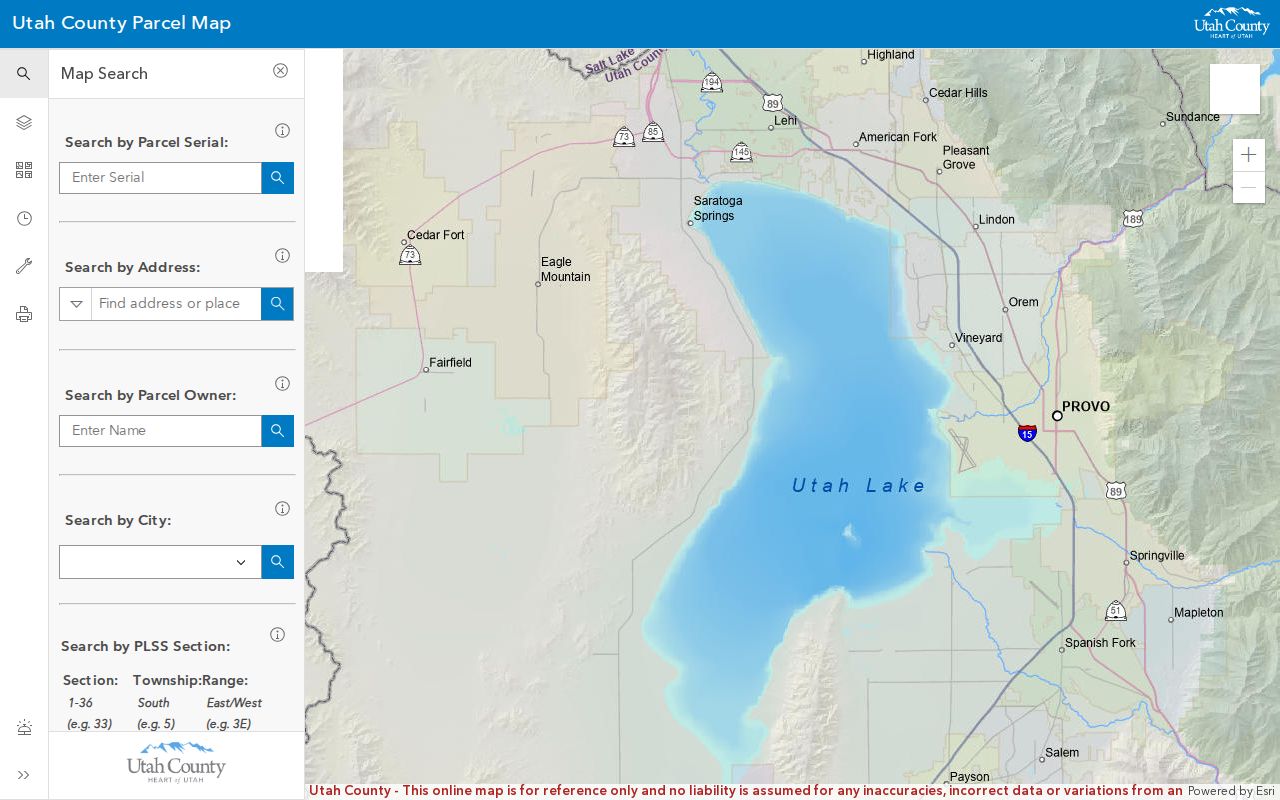
The result may show the situs, which means the parcel location, along with a separate owner mailing address used for tax notices. Neither field proves who lives at the property. For a historic Main Street house, compare owners with directories, newspapers, permits, and property-history nominations. For a newer subdivision, use the plat, parent parcel, planning packet, and building permit because an older city directory may predate the street. The parcel roll, abstract, map, and permit files overlap without proving the same fact.
Note: A Payson postal address and a Payson city parcel are not always the same thing, especially near annexed edges.
Find Payson Court Records by Name
Court level matters as much as a party name. Payson Justice Court handles qualifying local misdemeanors, infractions, traffic, and municipal-code matters. Fourth District Court handles felonies, broader civil cases, domestic matters, and probate in Utah County. Utah appellate courts hear appeals, and federal cases are held by the U.S. District Court for the District of Utah.
A public docket can show the case number, court and location, case title, party names and roles, filing date, case type, event entries, judge, status, disposition, and hearing details. A docket is the running case-event list, not the full file. Pleadings, orders, and judgments may require a clerk request. Juvenile, adoption, sealed, expunged, and other protected material remains unavailable or redacted.
| Court level | Typical Payson matter | Search route | Fallback |
|---|---|---|---|
| Payson Justice Court | Local qualifying offense or ordinance case | MyCase or XChange as eligible | Justice Court clerk |
| Fourth District Court | Felony, probate, domestic, broader civil | MyCase or XChange as eligible | District clerk or public terminal |
| Utah appellate courts | Appeal | Judiciary records routes | Appellate clerk |
| Federal District of Utah | Federal case | PACER | Federal clerk |
Choose a Payson Court Search Route
MyCase and XChange serve different users. MyCase is a free account-based service used mainly by a party to view that person’s own eligible Utah court cases. It is not an unrestricted public name finder. XChange is the judiciary’s electronic district and justice court search service for eligible public records, and registration, subscription, or search charges may apply. A clerk or public terminal remains the route for public material not delivered online.
The Utah MyCase access page explains its account and party-focused scope.
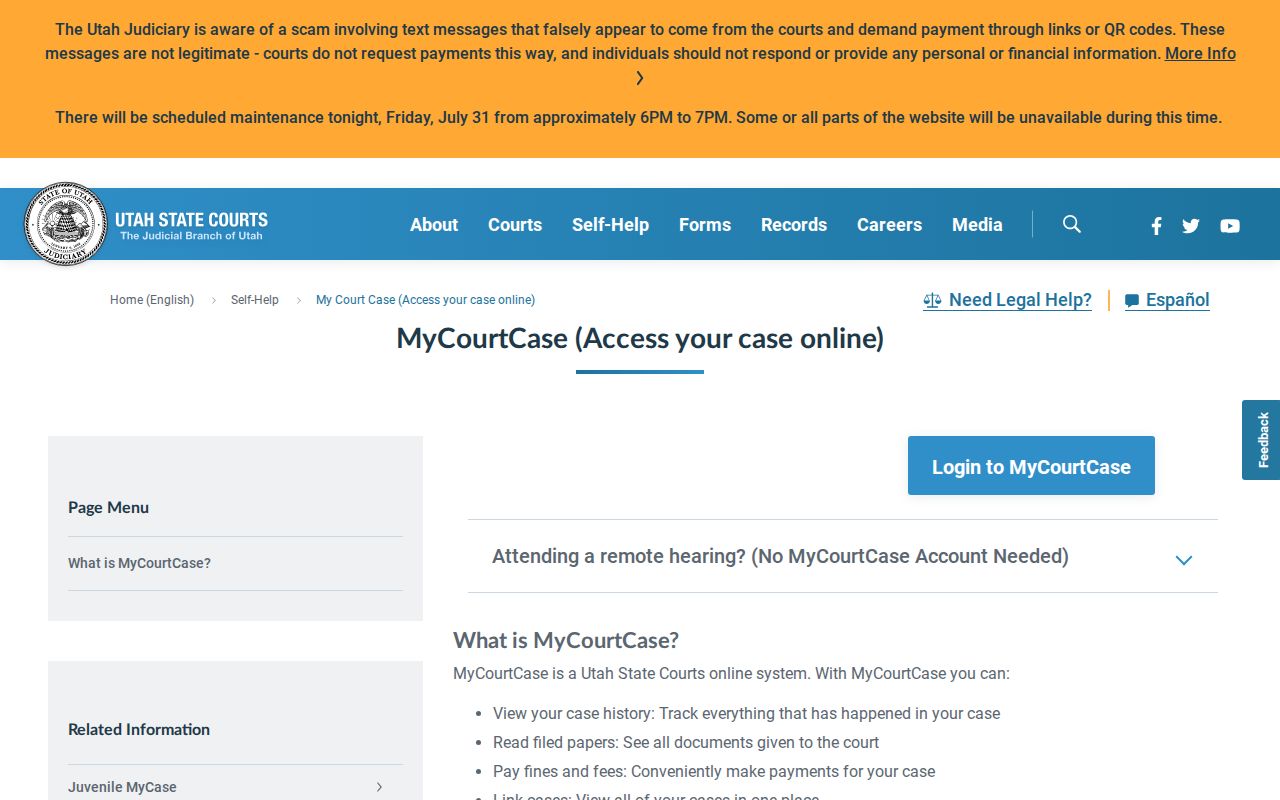
That screen is useful when the person searching is involved in the case. It should not be read as a complete public index of every Payson court party.
Search Payson Public Cases with XChange
XChange serves a broader public court-record role than MyCase. It covers eligible electronic district and justice court case information, while registration, subscription, and search charges may apply. Exact options in a live paid session were not verified, so use the judiciary's stated fields and do not assume a result limit.
The Utah XChange court records page describes the broader public electronic service.
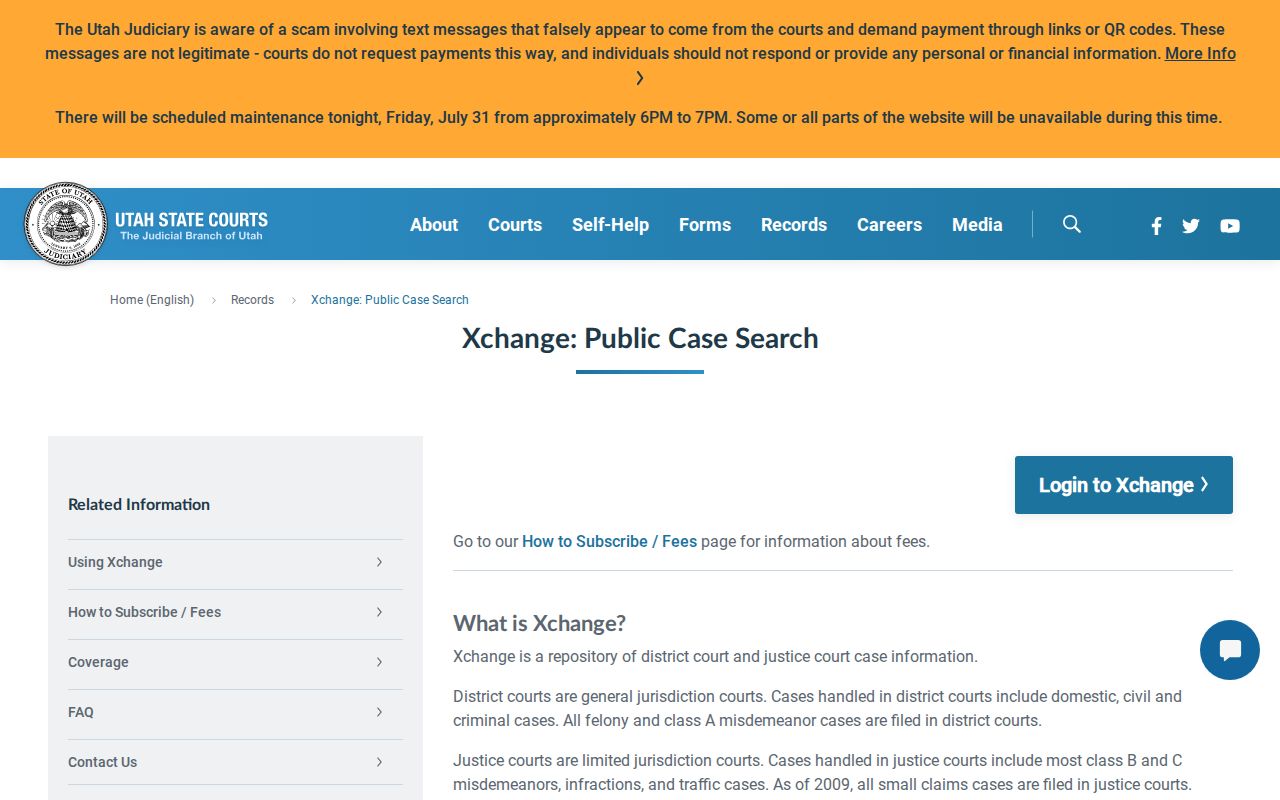
XChange can lead to public case details, but the clerk is still the authority for a file, copy, certification, or access question. Search with the party name, court or location, case type, case number if known, and a narrow filing range. Then use a disposition or order, not an initial allegation, to describe the outcome.
Access Payson Vital Records
Recent Utah vital certificates are not ordinary open people-search records. Utah Code § 26B-8-125 generally restricts birth certificates for 100 years, death certificates for 50 years, and marriage or divorce certificates for 75 years. During those periods, the subject, immediate family, guardian, designated representative, a person asserting a personal or property right, an approved researcher or agency, or someone with a court order may qualify with proof.
The Utah County Health Department has a Payson counter at 285 N 1250 E, third floor, for counter birth and death requests on Tuesday and Thursday, 8 to 11:30 a.m. and 1 to 4:30 p.m. Current photo identification, payment, and sometimes relationship proof are required. County mail processing may take up to one week, while state mail estimates run at least six weeks.
State vital records cover births, stillbirths, and deaths from 1905 forward, plus marriage and divorce abstracts for 1978 through 2010. Outside that abstract span, ask the issuing county for a marriage license or the district court for a divorce file. Older public material moves toward the Utah State Archives, including early Utah County marriage indexes from 1897 through 1905.
- Certified copy
- An official custodian-issued copy authenticated for formal use.
- Abstract
- A brief official summary, not the complete underlying case or license file.
- Qualified applicant
- A person or entity that fits the statutory access categories and supplies required proof.
Note: A public historical index does not make a recent Payson birth, death, marriage, or divorce certificate open to all requesters.
Trace Payson Families Through Peteetneet
Payson was settled in 1850 under the name Peteetneet. Historical catalogs, territorial records, and digitized newspapers may use either name, so both belong in a family search. Early residents predate uniform statewide vital registration. Their trail can run through Utah County land, probate, and court books, federal territorial census schedules, church sources, cemetery records, and local newspapers.
The Utah Historical Society digital collections add city directories and other scanned material to that older search. Payson City Library and the Payson Historical Society can help locate yearbooks, photographs, property surveys, family files, telephone books, cemetery compilations, and local histories, but no official published list fixes the exact years of every Payson directory or obituary index. Ask before assuming coverage.
The Saint Peter and Paul Orthodox Cemetery offers a distinct route into Payson’s Greek community. Search a surname in original transliteration, an anglicized form, and likely clerk spellings. Compare a marker or interment entry with a civil certificate, newspaper notice, census household, or probate record. Each source has a different purpose, and agreement across them is stronger than a single unsourced family tree.
Reconnect Through Payson School Records
Yearbooks, school newspapers, activity reports, and obituaries can help reconnect Payson classmates when a nickname or married surname breaks a direct name search. Nebo School District is the correct school jurisdiction. A graduation year, club, team, sibling, teacher, or dated address can distinguish people who share the same name.
Current staff pages answer whether someone now appears in a school role; they do not establish a complete student history. Historical yearbooks and local news provide dated snapshots. Pair the printed name and image with a later obituary, marriage record, professional license, or known family association before treating the match as settled. Private alumni rosters should remain private unless their access terms clearly allow the use.
This approach works best as a human connection trail, not as proof of a present address. People move, surnames change, and school records capture one point in time. Keep the year and institution attached to every name.
Find Payson Licenses and Businesses
A state professional license can separate two people with the same name by profession, license number, status, or expiration history. Payson municipal licensing answers a different question: whether a local business had city permission to operate. State business filings can add an entity name, number, status, type, principal address, registered agent, governing people, and filing history. Date each result because state registration, professional licensing, and city licensing renew on separate cycles.
The Utah professional license lookup accepts a name with a profession or a license number.
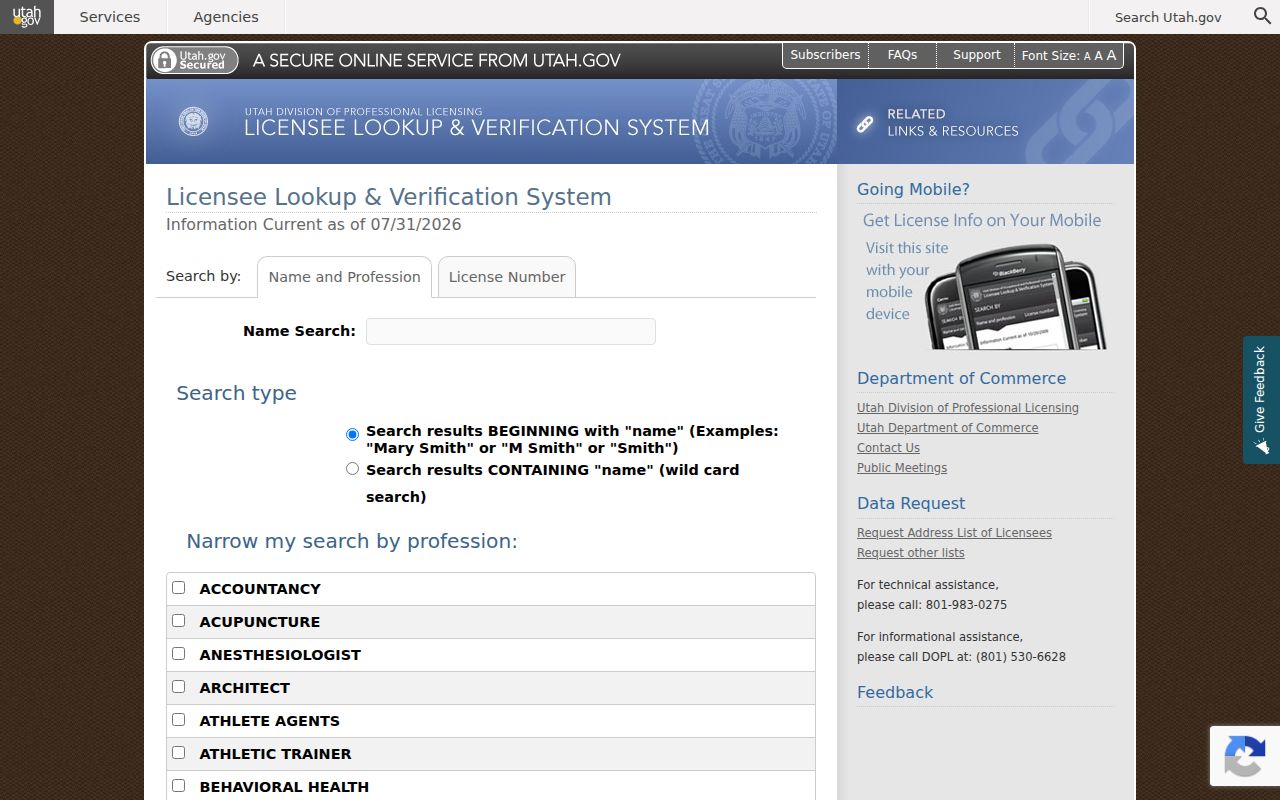
The form supports a name search with begins-with or contains matching, profession choices, and a license-number route. Results commonly identify the name, profession, number, current status, expiration, and history. A registered agent or filing signer acts in a stated role, so that appearance does not by itself prove ownership, residence, or a family tie.
Locate Payson Names in Unclaimed Property
Utah Unclaimed Property offers a free owner-name search for money or property transferred to state custody after the holder lost contact with the owner. A Payson association may appear through the owner name and an address tied to the reported property. The record is useful for finding a past connection, but it does not establish that the person still lives at that address.
The official Utah unclaimed property search provides the name-based lookup and claim starting point.
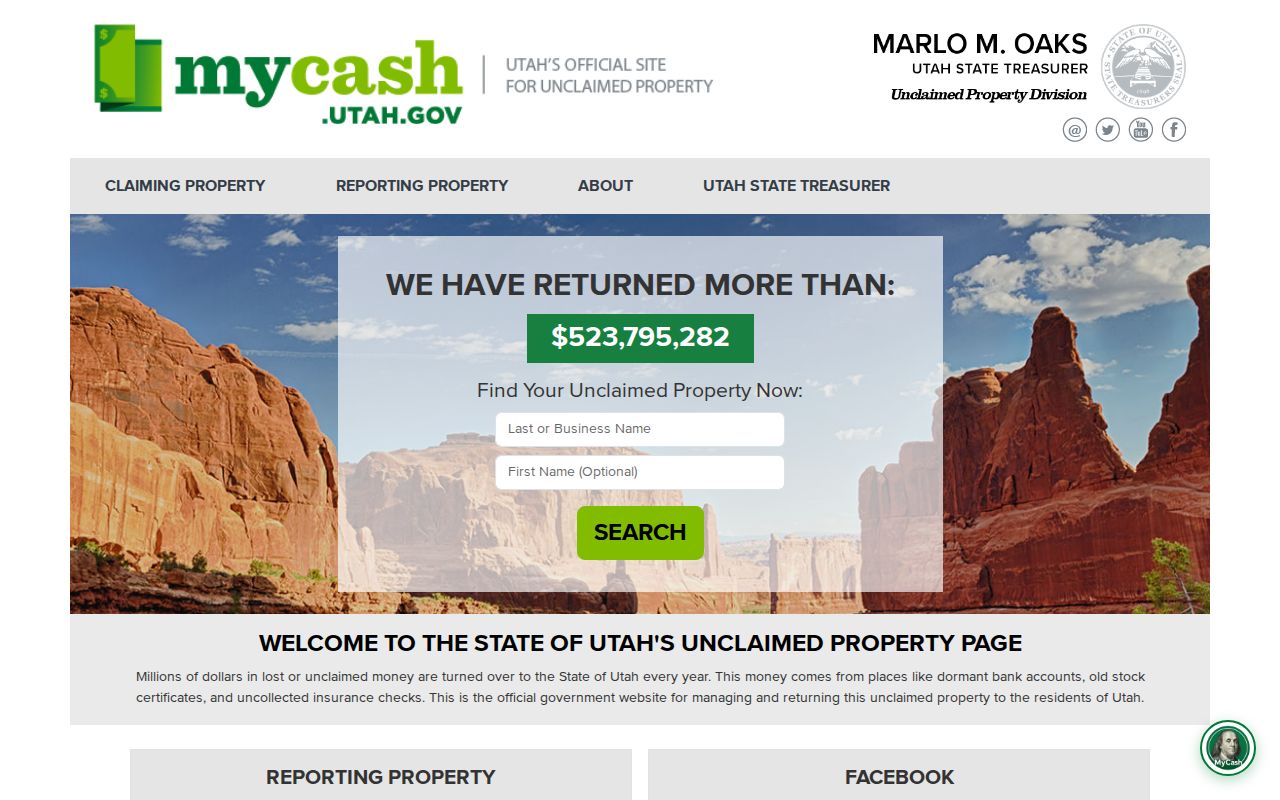
Try surname variations and given-name initials, then compare a result with a dated parcel, business filing, license, obituary, or directory. A claim requires the state’s identity and ownership process. Finding the same name is only the first step.
Note: Never pay an unknown caller to release a supposed award; begin through the official Utah service and verify any contact independently.
Request Payson Records When Offline
A record absent from a web search may still exist in an office book, microfilm series, archive catalog, or restricted image system. Utah’s Government Records Access and Management Act, known as GRAMA, covers city and executive-agency records subject to public, private, controlled, and protected classifications. It does not force an office to answer research questions or create a new list.
Send the request to the office that keeps the record. State the person or party name, date range, department, project or address, and any parcel, entry, license, or case number. Say whether inspection or an electronic copy will work, and set a maximum cost. A focused request helps the custodian locate an existing file and reduces avoidable search time.
- Search the agency’s posted documents and official index first.
- Identify the custodian from the record type and jurisdiction.
- Describe an existing record with names, dates, numbers, and a narrow subject.
- Choose inspection or copies and state an authorized cost ceiling.
- Keep the submission, response, and any denial or appeal instructions.
Ordinary GRAMA responses are due as soon as reasonably possible and no later than ten business days, subject to extraordinary circumstances. Qualifying expedited public-benefit requests have a five-business-day period. Reasonable actual production costs can apply, while inspection of public records during normal hours is free. The first fifteen minutes of staff time are ordinarily free, subject to statutory exceptions.
Confirm a Payson Search Match
Two independent records make a safer identity match than one name result. Compare stable details such as a middle name, age band, spouse, dated address, parcel serial, license number, entity role, or case number. Reject the match when dates, geography, or identifiers conflict. Never merge two Payson residents just because a broad index places both names in Utah County.
Official records and compiled commercial results also serve different roles. An official index points to a record held by a named custodian and can often lead to an image or certified copy. A compiled result may blend data from several sources, lag behind changes, or combine people. Use it only as a lead, then return to the relevant court, recorder, clerk, agency, library, or archive.
| Source type | Strength | Next check |
|---|---|---|
| Official index | Names the custodian and record | Open the image or request the file |
| Certified copy | Authenticates the custodian's copy | Read the facts and roles in context |
| Directory or newspaper | Connects a person to a dated place | Compare an official record |
| Compiled commercial result | May suggest another spelling or place | Verify every detail independently |